SEARCH RESULTS
Buscar neste site
195 resultados encontrados com uma busca vazia
- THE ART OF LIVING WITH ART
Exhibitions Archive < Back THE ART OF LIVING WITH ART OPENING 25 de jun. de 2020 CLOSING 31 de dez. de 2020 We have challenged ourselves to break the epochal and stylistic barriers, focusing on the intrinsic beauty of each of the pieces presented and looking to create a scenario of tranquility in which art is the vital and recreational element, creating amongst us a constant source of inspiration. Each pick is the result of a fine line of passion, holding us inescapably to the chosen object, which at times is a fruitful and unexpected encounter and in others a result of a long and persistent search. In this ephemeral architecture, we have aimed to recreate our universe, our passion for form, design, material and for the relations that establish between a piece and its surroundings. The selection of each piece, the search for its place, the readings provided by different angles, the various possible lightings, the dialogues established in-between the objects, the hunt for the final coherent composition, all of this composes our intimacy, constituting an integral part of what we call well-being. Previous Next
- SARA BICHÃO
Contemporary Art < Back SARA BICHÃO Lisbon, 1986 Sara Bichão lives and works in Lisbon. Has a degree (2008) and a master (2011) in Plastic Arts from Faculty of Fine Arts of the University of Lisbon. Has integrated several artistic residences like Residency Unlimited (2012, EUA), ADM-PIRA (2016, Mexico) or Artistes en Résidence (2017, France). Exhibits regularly since 2009. Solo exhibitions (selection): Encontra-me, Mato-te (2018), Fundação Calouste Gulbenkian, Lisbon; Coastal (2017) and Adrift in Space, Melt in Pace (2015), Barbara Davis Gallery, Houston; O meu sol chora (2016), Fundação Portuguesa das Comunicações in partnership with Galeria Bessa Pereira, Lisbon; Somebody’s Address (2016) and Open Gates (2014), Rooster Gallery, New York; Recheio (2014), Carpe Diem Arte e Pesquisa, Lisbon. Group exhibitions (selection): Chama (2018), Atelier- -Museu Júlio Pomar, Lisbon; Extática Esfinge (2017), CIAJG, Guimarães; Curar e Reparar (2017), Anozero, Biennial of Contemporary Art of Coimbra; O Que Eu Sou (2017), MAAT, Lisbon; Now, this is fucking too hot (2017, com Manon Harrois), Les Ateliers, Clermont-Ferrand; Puras Cosas Nuevas (2017), Pantalla Blanca, Mexico City; de repente bien (2016), Cantabria Central Library, Santander; }{ { } (2015, com Omar Barquet), Diagrama, Mexico City; Eccentric Exercise II (2015), KCB, Belgrado; Les Gens Heureux, Copenhagen (2014); Soundless Harmonies (2014), Artopia Gallery, Milão; Eccentric Exercise I (2013), Copenhagen; Uma Coisa a Seguir à Outra (2013, com Miguel Ângelo Rocha), Galeria Quadrum, Lisbon; Extending the Line (2012), Arevalo Gallery, Miami. Was awarded by Fidelidade Mundial - Young Artists Award (2009, honorable mention), by Anteciparte (2009, selected artist) and won the BPI / FBAUL (2008) in the discipline of painting. Her work is represented in several public collections: Fundação Calouste Gulbenkian, Lisbon; MAAT - Fundação EDP, Lisbon; Fundação Portuguesa das Comunicações, Lisbon; Figueiredo Ribeiro Collection, Lisbon; António Cachola Collection, Elvas; MidFirst Bank, Arizona; Twins Design, Houston; Fidelidade Mundial, Lisbon; Telo de Morais, Coimbra; Benetton Foundation, Milan; CAC, Malaga. Sem título, 2014 Grafite e marcador sobre papel. 21,05 cm x 29,5 cm Sem título, 2013 Grafite e tinta da china sobre papel Moleskine. 18,7 cm x 25,0 cm Sem título, 2013 Grafite e tinta da china sobre papel de Moleskine. 18,5 cm x 25,0 cm Sem título, 2012 Grafite e lápis de cor sobre papel de Moleskine. 18,5 cm x 25,0 cm Sem título, 2012 Marcador sobre papel de Moleskine. 18,7 cm x 25,0 cm Sem título, 2012 Marcador sobre papel de Moleskine. 18,7 cm x 25,0 cm Sem título, 2011 Aguarela e grafite sobre papel de Moleskine. 25,0 cm x 18,6 cm Sem título, 2014 Aguarela sobre papel de Moleskine. 12,7 cm x 21,0 cm Sem título, 2012 Aguarela sobre papel de Moleskine. 8,1 cm x 13,9 cm Sem título, 2012 Aguarela, lápis de cor e grafite sobre papel de Moleskine. 8,2 cm x 14,0 cm Sem título, 2012 Grafite e lápis sobre papel de Moleskine. 8,8 cm x 14,0 cm Sem título, 2012 Tinta acrílica e grafite sobre papel de Moleskine. 8,3 cm x 14,0 cm Sem título, 2012 Grafite, aguarela e lápis de cera sobre papel de Moleskine. 8,3 cm x 13,9 cm Sem título, 2013 Aguarela e grafite sobre papel de Moleskine. 8,2 cm x 13,9 cm Sem título, 2014 Marcador e lápis de cera sobre papel de Moleskine. 8,2 cm x 13, 9 cm Sem título, 2012 Tinta acrílica e marcador sobre papel de Moleskine. 8,9 cm x 14,9 cm Sem título, 2012 Tinta acrilica e aguarela sobre capa de Moleskine. 9,0 cm x 13,9 cm Sem título, 2013 Marcador sobre papel de Moleskine. 13,9 cm x 8,7 cm Sem título, 2012 Grafite e lápis de cera sobre Moleskine. 14 cm x 9 c Sem título, 2013 Caneta esferográfica sobre capa de Moleskine. 13,9 cm x 8,9 cm Untitled, 2013 Wood and acrylic paint 123cm (H) x 2cm (W) x 2cm (D) Signed and dated This work was exhibited at Carpe Diem, Lisboa 2014 Untitled, 2014 Acrylic on woodboard 66,5cm (H) x 52,0cm (W) x 2,0cm (D) Signed and dated This work was exhibited at Carpe Diem, Lisboa 2014 Untitled, 2014 Acrylic on woodboard 91,3cm (H) x 11,0cm (W) x 3,3cm (D) Signed and dated This work was exhibited at Carpe Diem, Lisboa 2014 Astuto / Sly, 2015 Wood, canvas, fabric, leather, steel, cord and cotton 110cm (H) x 87cm (W) x 12cm (D) Untitled, 2014 Plaster ball and leather 39,0cm (H) x 6,0cm (W) x 6,3cm (D) This work was exhibited at Rooster Gallery, on the individual exhibition "Somebody’s adress” in 2014
- PEDRO CABRITA REIS
Contemporary Art < Back PEDRO CABRITA REIS Lisbon, 1956 Born in 1956 in Lisbon, where he currently lives and works. He enrolled in the Lisbon Academy of Fine Arts in 1973 to study painting, and had his first solo exhibition in 1981. His work since then has evolved into a complex oeuvre comprising a variety of genres ranging from drawing and painting to sculpture and installation. With an acute sense of space occupation, whether an exhibition hall or outdoor urban and natural landscapes, Reis’s artworks delve into issues related to memory and to construction and architectural processes, by using diverse unsophisticated materials, such as wood, glass, plaster, stone, plastic and metal, sometimes in combination with ordinary household objects. He participated in Documenta 9, Kassel, in 1992, as well as the 21st and 24th São Paulo Biennales in 1994 and 1998, respectively. In 2003, he represented Portugal at the Venice Biennale. Pedro Cabrita Reis has exhibited widely in prestigious Portuguese and foreign art museums and centres, namely “One after another, a few silent steps”, a retrospective that toured Hamburg (2009), Nimes (2010) and Leuven (2011) before being staged at the Lisbon Berardo Museum in 2011, and “States of Flux – Pedro Cabrita Reis”, at Tate Modern, London, in 2011. Following the same guiding principles as the rest of his artistic endeavour, Reis’s public art include, in addition to Uma escultura para Santo Tirso [A Sculpture for Santo Tirso], built for the 6th Santo Tirso International Symposium of Contemporary Sculpture in 2001, Da cor das flores [On the Colour of Flowers], a public sculpture created in 2001 for the Bemposta Dam, and Castelo [Castle], rising at the Contemporary Sculpture Park of Vila Nova da Barquinha (Almourol) since 2012. 1+1, 2003 Plywood and found wood doors 222cm x 64cm x 77cm Photo by PCR studio Antwerpen stairs, 1987 lacquered aluminium 173,5cm x 206,0cm x 7,0cm
- GERRIT RIETVELD ZIG ZAG CHAIR, 1960s
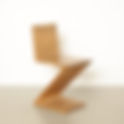
Miscellaneous < Back GERRIT RIETVELD ZIG ZAG CHAIR, 1960s Zig Zag Chair Designer: Gerrit Rietveld (Netherlands, 1888 - 1964) Gerard A. van de Groenekan manufacture, Netherlands 1960s Wood H 75 cm x W 37 cm x D 44 cm x SH 43 cm Note: signed with the manufacturer's mark on the underside - H.G.M. G.A.V.D Groenekan De Bilt Nederland. The Zig Zag chair is part of the collections of the world's greatest museums, such as the Metropolitan Museum of Art (Met) in New York, the Vitra Design Museum in Weil am Rhein, Germany and the Victoria&Albert Museum in London.
- QUANDO SOMOS 2 SOMOS TRÊS
Exhibitions Archive < Back QUANDO SOMOS 2 SOMOS TRÊS Sara Bichão & Manon Harrois OPENING 10 de out. de 2018 CLOSING 17 de nov. de 2018 Quando somos 2 somos três is a permanent movement, the choreography of a discussion. Manon Harrois and Sara Bichão have been sharing this path with a view to a common vertex. In the fluency of the steps, the complicity of the impulse echoes, sharing the unknown. A horizon generated by four arms that articulate in pairs. Brochure (pt download) Previous Next
- MISUYA LOW CABINET, early 19th c.
Miscellaneous < Back MISUYA LOW CABINET, early 19th c. Misuya Low Cabinet Japan, Edo period, early 19th century Lacquered wood with sliding doors H 85 cm x W 182 cm x D 48 cm
- ANTONI TAPIES
Modern Art < Back ANTONI TAPIES Untitled 1984 Etching on Paper 44 x 59 cm
- PEDRO CALAPEZ
Contemporary Art < Back PEDRO CALAPEZ Lisboa, 1953 Pedro Calapez (b. 1953) on being an artist : " Art is something that may bring you strange doubts. you have doubts about what it is; you might not even know what it is. in reality, anything can be art: it depends on our attitude towards certain objects or doing certain things. i think it is necessary to have a special talent, not in the sense of something that only a few possess but something that could be awake in each one of us and that begins with the realization that we have capacities that allow us to feel and understand, on different levels, the small things we do or see and that are all around us. My work neither explains nor solves society’s needs and problems. visual force is very important in my painting and through drawing and painting, the aim is to take something from what surrounds us for ourselves. but this appropriation of the other, of that which is outside us, is a capacity we all have. we just have to put it into action. we don’t need to be painters or writers. it’s just a question of talking, talking to each other. this is the talent that awakens our capacity not to remain secluded from the world around us. I make paintings, objects. i make them firstly for me. i make them because i like to. i make them because i want to reveal the small things i observe. i get enthusiastic about the small things i see in nature or about a drop of paint falling on a piece of paper. the most important thing is the possibility of doing what i like, having the possibility of looking at and understanding my relationship with myself and others . " “Um corpo entre outros 30”, 2020 From the series “Um corpo entre outros” Mixed media on museum card H 152 x W 102 cm "Um corpo entre outros 23", 2020 Mixed mid on acid free paper 460gsm (approx.) Arches H 152 x L 102 cm "Um corpo entre outros 48”, 2020 Mixed mid on acid free paper 460gsm (approx.) H 152 x L 102 cm
- QUEBRANDO BARREIRAS — “POSTMODERN” FURNITURE
Exhibitions Archive < Back QUEBRANDO BARREIRAS — “POSTMODERN” FURNITURE Fernando Pinto Coelho OPENING 19 de set. de 2018 CLOSING 19 de out. de 2018 Exhibition in the context of the ninth edition of Bairro das Artes where we presented a set of “post-modern” furniture designed in 1980 by Architect Fernando Pinto Coelho. «Galeria Bessa Pereira - Fine Arts & Furniture presents a selection of pieces of furniture, designed by the architect Fernando Pinto Coelho, under the title “Quebrando Barreiras”. Fernando Pinto Coelho (Coimbra, 1951) is a multifaceted personality who has developed throughout his life a series of collaborations and activities very close to the sphere of art, without losing sight of architecture. Collaborated with the Academic Association of Coimbra and with the Circle of Plastic Arts of Coimbra (CAPC); worked in the Design Office of Architect João Baptista in the 1970/71 biennium, as well as in the SAAL project, with interventions in the public space. In the same decade, he was part of the Puzzle Group which developed, in an activist way, interventions, plastic art exhibitions and performances between 1976 and 1981. These dates are important because, on the one hand, they frame a new political phase of freedom and democracy that Portugal he lived after the Carnation Revolution in 1974, a time when Portuguese society was beginning a definitive change in interest and access to culture and the visual arts. Let us remember the year 1977 with the historic exhibition Alternative 0, at the Galeria de Arte Moderna, in Belém, and at the Quadrum Gallery, also in Lisbon, the performance “Rotura” by Ana Hatherly. On the other hand, 1981 is the year in which the Puzzle Group dissolves, if we can say so, and it is coincidentally the date on which the pieces now on display were created by Fernando Pinto Coelho. The exhibition's title, “Quebrando Barreiras”, evokes the motto of Postmodernism in its critique of Modern Architecture, that is, to overcome established models and canons, in a radical attitude that opened new fields for the appearance of other formal and pictorial strategies that they envisaged another aesthetic order and another way of using it, more playful, as if each element of everyday life was a piece of a game, or an endless puzzle. This transformation proved to be more eclectic, with a palette of colors and a formal construction that announced a kind of new futurism, which, while not being held hostage by the functionality of the object of use, did not depart from it, but expressed an artistic and transforming act, electrifying, hybrid, idiosyncratic, and thus iconic. The exhibits were designed specifically for a private home located in São Martinho do Campo, in the north of Portugal; it was the beginning of the 1980s, a time when Portuguese society was approaching Europe, and this exhibition places in the same wake of a challenge to the current rules and barriers of that time and cultural cosmopolitanism, recently arrived at the spirit of freedom and the mess of the established certainties. At the international level, another equally provocative architect, designer and philosopher must be mentioned here as an important agent of this transmutation movement: Ettore Sottsass (1917-2007), member of the Memphis Group, a design collective based in Milan. , the different areas and currents of contemporary culture began to intersect and integrate other forms of artistic expression, such as the Memphis designation, appropriate to a Bob Dylan song, "Stuck Inside of Mobile with the Memphis Blues Again". This permeability to different contexts is present in the design pieces of this post-modernist period, in which objects took on a sculptural form and were covered by a range of colors that we can associate with painting. In a way, it is as if the spirit of the Pop Art movement has transformed our functional and everyday imagery, opening up another field of possibilities, sometimes strident, but certainly challenging in our relationship with architecture and design. The pieces designed by Fernando Pinto Coelho emerge from this close relationship between the projectual dimension and the manuality of artistic making, between the logic of the game, what is playful, and the possibility of changing the aesthetic and functional perception of an object and the space it it determines, as an act of freedom and experimentation in which an idea, or a drawing, is embodied in a chair, on a table, or even, for example, on a floor. It is as if we were entering a graphic or pictorial image, in the dimensions that the body requires to exist in space, but with other aesthetic coordinates that sensorially alter our relationship with it. » João Silvério Informative triptych (pt download) Previous Next
- ABOUT | GALERIABESSAPEREIRA
OUR MISSION We are commited to providing our customers with works of art they'll cherish and live with, developing emotional connections and enriching their lives < HOME We have challenged ourselves to break epochal and stylistic barriers, focusing on the intrinsic beauty of each of the artworks presented and looking to create a scenario of tranquility in which art is the vital and recreational element, creating amongst us a constant source of inspiration. From Modern design to Roman archeology, each of our acquisitions is the result of a fine line of passion, holding us inescapably to the chosen object, which at times is a fruitful and unexpected encounter and in others a result of a long and persistent search. In the ephemeral architecture of our gallery exhibitions, we have aimed to recreate our universe, our passion for form, design, material and for the relations that establish between a piece and its surroundings. Our gallery is located in Rua de S. Bento, the traditional place for galleries in Lisbon. Galeria Bessa Pereira in PRESS Visit us Business Hours 10h00 – 13h00; 14h30 – 19h00 Monday to Saturday Rua de São Bento 426, Lisboa